

The Wound of Separation: When Suffering Makes Us Feel Cut Off from Love

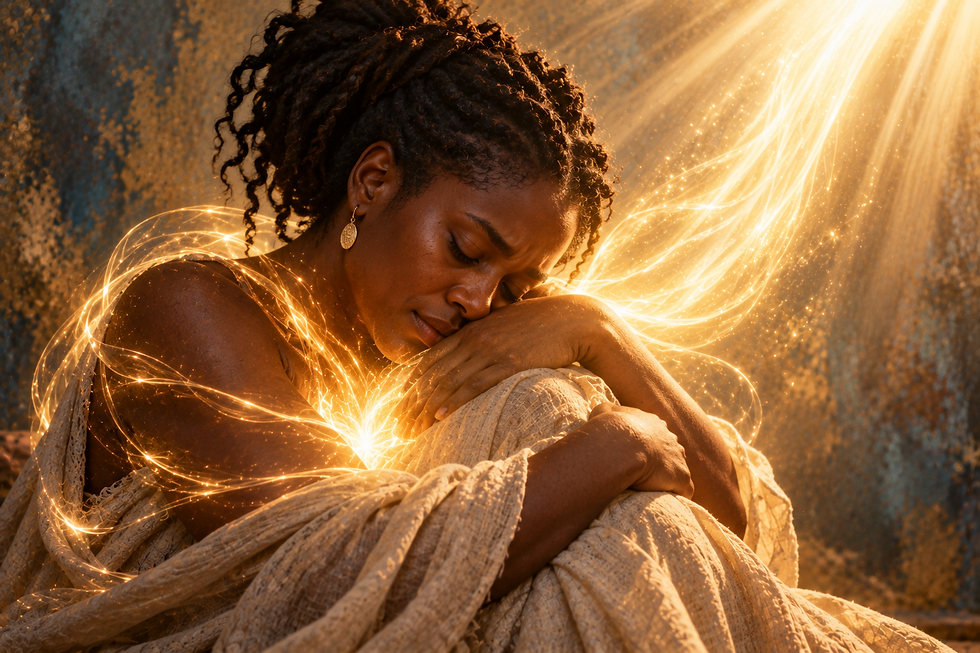
There are experiences that do more than hurt us. They can alter our relationship with ourselves, with other people, with the Sacred, and with life itself. Trauma, violence, betrayal, abandonment, oppression, grief, and other forms of suffering can leave us feeling profoundly alone, even when we are surrounded by people who love us. We may feel disconnected from ourselves, unable to trust what we once trusted, or spiritually disconnected from a reality that once seemed meaningful and alive.
I call this the Wound of Separation. It is not a particular kind of trauma or a diagnosis. It is a way of understanding something I have encountered repeatedly in my own healing journey and in nearly two decades of healing and teaching: suffering can create the experience that we have become separated from something essential—from our deepest nature, from others, from the Sacred, or from Love itself.
The distinction between the experience of separation and actual separation is fundamental to the Way of Love-Light. I do not believe that trauma or suffering can destroy what I call the Individualized Soul, the deeper consciousness and identity that each of us is. Nor do I believe that suffering removes us from Love-Light, the deeper reality within which life arises and belongs. But suffering can profoundly obscure our experience of both. The separation can feel absolute even when, at another level, it is not.
How Separation Becomes Organized Within Us
When we are wounded, we do not simply remember what happened. We adapt to it. The body learns. The nervous system learns. We develop beliefs about ourselves and other people, expectations about what relationships will bring, and ways of protecting ourselves from being hurt again. Some of these adaptations may have been essential to surviving the circumstances in which they developed.
A child who repeatedly experiences abandonment, for example, may learn that depending upon other people is dangerous. Someone who has lived with violence may become exquisitely alert to shifts in another person's voice, expression, or mood. A person who has been punished for speaking may learn to remain silent, while someone whose boundaries have repeatedly been violated may build walls that make intimacy difficult.
These responses do not arise because the person has somehow failed to heal correctly. They arise within particular causes and conditions and often represent intelligent attempts to survive them.
Over time, however, a survival strategy can remain active after the conditions that created it have changed. What once protected us can begin to constrain us. A person may consciously understand that the present is different from the past while still responding to relationships, opportunities, conflict, vulnerability, or intimacy as though the earlier danger remains immediately present. In this sense, the Wound of Separation can become organized within the body and nervous system, beliefs, relationships, choices, and identity.
This is one reason that feeling disconnected from yourself can be difficult to resolve simply by deciding to think differently. The disconnection may not exist only as an idea. It may have become woven into how you protect yourself, whom you trust, what you expect, what you allow yourself to want, and even what you believe is possible.
The Wound of Separation Is Not Actual Separation
Spiritual teachings can become particularly problematic here if they move too quickly to transcend the human reality of suffering. Telling someone who has experienced violence, devastating loss, betrayal, or oppression that they remain surrounded by Love may be spiritually meaningful in one context and profoundly invalidating in another.
The fact that I understand Love-Light as the deeper ground of existence does not mean that every human experience is loving. People harm one another. Systems harm people. Terrible things happen, and spiritual language should never be used to erase their consequences.
This is why I hold together what I call the Human and Soul realities. The human reality includes what actually happens to us and around us: love and loss, choice and consequence, relationship, circumstance, injustice, violence, and harm. The Soul reality places a human life within the longer trajectory of the Individualized Soul. Neither reality should be used to cancel the other. A larger spiritual meaning does not make suffering unreal or justify harm, while the reality of suffering does not encompass the entirety of who we are.
The Wound of Separation exists at precisely this intersection. Something real happened. It affected us. It may have changed the course of our lives. Yet what happened does not possess the power to erase the deeper reality of who we are.
This distinction matters because otherwise we can easily make one of two errors. We can spiritualize suffering so completely that we minimize the wound, or we can become so identified with what happened that the wound comes to define the boundaries of who we believe ourselves to be. Healing asks us to honor the reality of the wound without granting it the final word.
The Sacred Promise
Within the Way of Love-Light, I call what lies beneath this understanding the Sacred Promise: no matter how deeply we have been wounded, what has been wounded has never been cast outside Love. Trauma cannot permanently sever us from Love-Light, destroy the Individualized Soul, or erase Who We Truly Are.
The Sacred Promise is not a promise that life will protect us from suffering. Clearly, it does not. Nor is it a promise that everything will work out as we hope, that every wound will completely heal, or that spiritual practice will spare us from the consequences of being human. It does not require us to forgive people who have harmed us, declare suffering necessary for our spiritual development, or search for a hidden blessing in everything that has happened.
It is a much more fundamental claim: the felt absence of Love is not the absence of Love.
That distinction has mattered deeply in my own healing and in the healing work I have done with others. There are periods of life in which Love does not feel present. Sometimes what we encounter instead is fear, rage, grief, numbness, despair, or an inability to feel very much at all. Healing does not require pretending otherwise. The Sacred Promise allows us to take the experience of separation seriously without concluding that separation is the deepest truth.
Healing the Wound of Separation
If the Wound of Separation can become organized throughout our lives, then healing it is rarely a matter of changing one belief. Healing is a movement toward greater wholeness through which what has become fixed or bound can begin to move and our wounds become less able to organize our bodies, beliefs, relationships, choices, and identities.
Sometimes this movement begins through psychotherapy or another form of psychological healing. Sometimes it unfolds through spiritual practice, relationship, creativity, community, work with the body, or shamanic healing. Often more than one pathway contributes to it. No single modality owns the human movement toward wholeness, and different kinds of wounds may require different forms of care.
In the Way of Love-Light, I understand healing as part of a Natural Pathway of Transformation: Entering, Opening, Transmuting, Remembering, and Illuminating. These are not stages we complete once and leave behind. Healing is nonlinear, and we may return to familiar material at another depth of consciousness and experience. What matters is that something that has remained fixed can begin to move; what has been obscured can become available again; and what becomes available can gradually change how we return to our lives.
One of those movements is Remembering. Remembering is not primarily about recovering information about the past. It is the gradual recovery of Who We Truly Are beneath the adaptations that have formed around the Wound of Separation. As those adaptations become less dominant, we may gain greater access to capacities that were always present but could not be fully lived: sensitivity without overwhelm, strength without armor, compassion without rescuing, a voice that can speak without disappearing or attacking, or an ability to remain connected without abandoning ourselves.
Belonging Is Not Something We Earn
This brings us to another dimension of the Wound of Separation: belonging. Many people spend enormous portions of their lives attempting to secure belonging through achievement, relationships, usefulness, spiritual attainment, conformity, caretaking, or being who other people need them to be. Human belonging matters profoundly, and exclusion from families, communities, institutions, and societies causes real harm. A spiritual understanding of belonging should never be used to pretend otherwise.
But beneath these contingent forms of belonging, I understand there to be something more fundamental. Fundamental Belonging is the condition of already existing within and belonging to Love-Light. It is not something we earn by healing enough, becoming spiritually evolved enough, behaving correctly, or proving our worthiness. Wounding can obscure our experience of this belonging, but it cannot abolish it.
For me, this changes the question at the center of spiritual healing. Instead of asking only, How do I become worthy of Love, connection, or belonging?
We can eventually begin asking, What has made it so difficult for me to experience the belonging that is already mine?
That question does not eliminate the work of healing. It gives the work a different ground.
Healing the Wound of Separation is therefore not about becoming someone who can finally qualify for Love. It is about allowing what has become wounded, frightened, defended, or bound to move toward greater wholeness so that more of Who We Truly Are becomes available to the life we are actually living.
The wound is real. The separation can feel real. But they are not the whole story.
Exploring Healing
If you recognize ways that trauma, loss, betrayal, or other experiences have left you feeling disconnected from yourself or from a deeper sense of belonging, Shamanic Healing can be one doorway into working with what has become fixed or bound. In my 90-minute Shamanic Healing sessions, we work with what is present and ready to be encountered rather than imposing a predetermined meaning or outcome on your experience.


Comments